Non-profit social enterprise · Kisaasi, Kampala · Est. 2026

Rooted in Alkebulan.
Built by communities.
Growing for Africa.

A non-profit social enterprise working at the intersection of waste, climate change, energy, agriculture and construction.

KEBULAN CYCLE CLEAN ENERGY AGRICULTURE CONSTRUCTION RESTORING DIGNITY · REBUILDING LIVELIHOODS · REGENERATING OUR GARDEN
Waste·Climate change· Energy·Agriculture·Construction
What we do

Three pillars. One circular system.

Every output becomes the next input. Nothing is wasted. Everything cycles.

Clean renewable energy

Biogas, Bio-CNG, solar PV, wind — locally fabricated, locally owned.

Climate-smart agriculture

Agroforestry, Black Soldier Fly, smart irrigation — restoring soil and raising yields.

Green construction

ISSB blocks, plastic boards, natural fibres — affordable dignified housing.

Our 2030 targets

Impact at scale

2,000+
youth & women trained
25,000+
tCO₂e/yr climate impact
5
demonstration hubs
250+
enterprise groups
5,000+
households on clean fuel
60%
female beneficiaries
How we work

Five approaches. Training into thriving.

01

Demonstration hubs

Real enterprises — not classrooms — anchored in the communities we serve.

02

Group formations

Graduate groups, not individuals. The strongest predictor of enterprise survival.

03

Seed grants & revolving funds

UGX 2–5M per group to launch, building a permanent local capital base.

04

Digital solutions

BioTrack Uganda + MTN Mobile Money — auditable, scalable, trustworthy.

05

Advisory desk

We broker offtake agreements. Supply without demand is activity without livelihoods.

Flagship project

BioGas Uganda Initiative

Uganda's first vertically integrated biogas purification, compression, and Bio-CNG cylinder distribution enterprise.

2,000cylinders/month Yr 3
5,000+households clean fuel
15,000tCO₂e/yr verified
USD 765KYear 3 revenue
Bio-CNG 15–20% cheaper than LPG · Gold Standard carbon credits

Walk the cycle with us

USD 1.5M total 3-year investment. 60% directly into communities. 0% overhead.

› About us

Our story, our purpose

A non-profit social enterprise headquartered in Kisaasi, Kampala. Founded 2026.

Founded 2026·Kisaasi, Kampala·Non-profit social enterprise
Who we are

Rooted in Alkebulan

Kebulan Cycle is a non-profit social enterprise headquartered in Kisaasi, Kampala, Uganda. Founded in 2026, we restore the dignity of vulnerable youth and women by turning waste, land, and indigenous knowledge into dignified, sustainable livelihoods.

Kebulan derives from Alkebulan — the oldest recorded name for Africa, used by ancient scholars to mean "Mother of Mankind" or "Garden of Eden."

Vision: A regenerated Africa where every young person and woman has dignified, sustainable livelihoods rooted in community, nature, and the circular economy.

Mission: To restore dignity through circular-economy-based livelihoods, advancing indigenous, innovative, and nature-based solutions to poverty, unemployment, climate change, and waste.

UGANDAN-LED · COMMUNITY-ROOTED
Strategic objectives 2026–2030

Our five-year commitments

2,000+
youth and women trained
5
demonstration hubs
250+
active enterprise groups
25,000+
tCO₂e annually verified
65%
commercial self-sufficiency by Year 4
1
East Africa Circular Economy Replication Toolkit
› Clean energy

Powering Uganda's clean energy future

More than 90% of households cook on charcoal or firewood. Less than 30% have reliable grid electricity. We tackle both.

Country Coordinator: Carol Aboth·Biogas·Solar PV·Wind
Biogas & Bio-CNG

From waste to clean cooking fuel

Community digesters: 3–10 m³ fixed-dome and ferro-cement digesters serving 5–15 households each, built from entirely local materials.

Industrial purification: WPSS systems upgrading raw biogas to >96% methane Bio-CNG, compressed to 200–250 bar for cylinder distribution.

Carbon credits: Gold Standard registration. 60% of carbon revenue to feedstock-supplying farmers via mobile money.

waste in digestate → >96% methane · 200–250 bar 15–20% cheaper than LPG
Solar photovoltaic

Solar for water, crops, and productive use

30–60% yield increase · 50% water saving

Solar borehole pumps

Water points, schools, health centres — operated by Water Users Committees (40%+ women).

Solar drip irrigation

30–60% yield increase. 50% water savings. Zero fuel costs on 0.25–2 ha plots.

Solar home systems

Pico-grids for refugee-hosting and remote rural communities outside the grid.

Technician training

Youth certified as PV installers through national skills authorities.

Wind energy

Wind for Karamoja and the highlands

Turbine range1–10 kW community-scale
Target areasKaramoja, Rwenzori foothills
ApplicationWater pumping, processing, off-grid power
System typeStandalone + hybrid solar-wind
1–10 kW · Karamoja & Rwenzori foothills
› Climate-smart agriculture

Restoring soil. Raising yields. Building resilience.

70% of Uganda's population are smallholder farmers. Indigenous knowledge meets circular techniques.

Country Coordinator: Dinnah Kwarisiima·Agroforestry·BSF·Smart irrigation
Agroforestry & bamboo

Planting the circular economy into the landscape

Bamboo and native trees yield construction material, biomass fuel, food, and erosion control simultaneously — restoring degraded land while generating income.

Bamboo on degraded landNative fruit & timber trees Fodder treesCoffee & banana shade systems Bamboo processing centresGold Standard carbon
600
hectares agroforestry by 2030
2,000+
tonnes organic waste diverted/yr
600 ha agroforestry by 2030
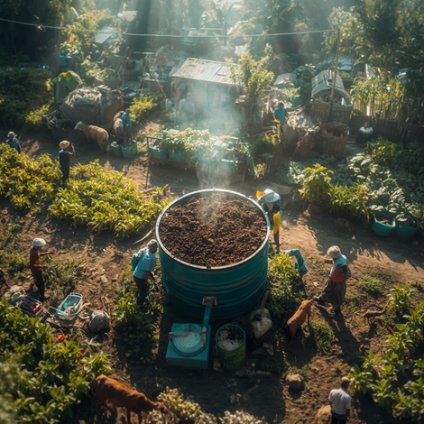
Black Soldier Fly (BSF)

Turning waste into protein

ORGANIC WASTE PROTEIN FEED ORGANIC FERTILIZER BETTER HARVESTS 50–200 kg waste/day diverted 35–42% protein feed + frass fertilizer

Feedstock

50–200 kg organic waste diverted per day — market waste, brewery grain, banana peels, food waste.

Products

Larvae meal (35–42% protein) for poultry & fish farms. Frass sold as certified organic fertilizer.

Enterprise income

UGX 300,000–800,000 per month net income at steady state (12 months post-launch).

Training

4-week intensive at our hub. Participants build and operate a real unit — not from a textbook.

› Green construction

Building dignified homes from local materials

Uganda has a 1.4 million unit housing deficit. Affordable, climate-adapted housing built by local people.

Country Coordinator: TBD·ISSB blocks·Plastic boards·Passive solar
Sustainable materials

ISSB compressed soil blocks

No kiln-firing. Made on-site — 90% local soil, 6–8% cement binder. Interlocking design.

Plastic-to-building boards

Shredded plastic waste heated and pressed into rigid panels for walls, partitions, and roofing.

Natural fibre composites

Banana stem, sisal, and papyrus pressed with natural binders into insulation panels.

Bamboo structural elements

Low-rise housing, scaffolding, and roofing trusses from sustainably harvested bamboo.

Passive solar design · Rainwater harvesting · ISSB blocks
Energy efficiency & water recycling

Passive cooling

Cross-ventilation + thermal mass + roof overhangs. 60–80% reduction in artificial lighting.

Greywater treatment

Reed bed systems returning clean water for irrigation and toilet flushing.

Eco-san toilets

Human waste safely converted to fertilizer — closing the nutrient loop.

Rainwater harvesting

First-flush diverters + 6-month dry-season storage integrated into every building design.

› BioGas Uganda Initiative

BioGas Uganda Initiative

Uganda's first vertically integrated biogas purification, compression, and Bio-CNG cylinder distribution enterprise. Reference: BGU/2026/001.

WPSS technology·Ankole cattle corridor·Gold Standard carbon·Mobile money payments
FEEDSTOCK DIGESTION PURIFICATION HOUSEHOLDS >96% CH₄ Bio-CNG clean cooking 🌱 Gold Standard carbon credits → 60% revenue to farmers via mobile money

Building the cattle corridor's clean energy future

Starting in Mbarara and Kiruhura — Uganda's densest cattle zones — connecting 200+ smallholder dairy farmers per hub. Manure becomes Bio-CNG cylinders priced 15–20% below LPG. Carbon credits return revenue to farmers via mobile money.

2,000cylinders/month Year 3
5,000+households on clean fuel
15,000tCO₂e/yr Gold Standard
150+direct jobs, 40% women
USD 765KYear 3 revenue
Project phases
Phase 1

Ankole cattle belt

Mbarara and Kiruhura. ~3.9M head. Established dairy cooperatives. Primary biogas feedstock zone.

Phase 2

Central + Kampala urban

Nakaseke, Masindi. Plus Kampala slaughterhouse and municipal organic waste.

Phase 3

Eastern highlands

Mbale (coffee waste) and Fort Portal (mixed agriculture).

Technology

WPSS upgrades raw biogas to >96% methane Bio-CNG. Stages 1–3 built by Ugandan welders — saving 70–86% versus imported equivalents.

Compression200–250 bar
Price vs LPG15–20% cheaper
DistributionSACCO & agro-dealer networks
Farmer paymentUGX 150–250/kg DM, same-day Mobile Money

Funding ask

EUR 400,000 – 550,000

Grant + technical partnership · Phase 1

› Where we work

Where the need is greatest

Across Uganda's central region, the cattle-keeping corridor, high-poverty districts, and refugee-hosting communities.

Kisaasi, Kampala·14.2M cattle·1.5M+ refugees·66% poverty in Karamoja
Uganda context

Extraordinary potential. Structural barriers.

48.6M
Population (UBOS 2023)
~75%
Population under 30
~80%
Youth unemployment (15–35)
>90%
Households on biomass cooking
28,000
Deaths from indoor air pollution/yr
1.4M
Affordable housing deficit
14.2M
Head of cattle
1.5M+
Refugees hosted in Uganda
Kampala Ankole Belt Karamoja West Nile Eastern Acholi Hub / main areaProgramme regionHigh priority district
Cattle keeping corridor

Uganda's largest biogas opportunity

Sub-region
Cattle
Why we work here
Ankole Belt
~3.9M
Densest cattle; dairy cooperatives; primary biogas feedstock zone
Central Belt
~2.1M
Mixed cattle & crop; proximity to Kampala
Karamoja
~2.5M
Pastoralist communities; extreme poverty; livelihood diversification
Lake Victoria Crescent
~1.4M
Peri-urban dairy; market access; pilot zone

Karamoja

~66% poverty

Smart irrigation, agroforestry, solar WaSH, BSF.

Acholi

~33% poverty

Post-conflict youth livelihoods, ISSB, biogas.

West Nile

~30% poverty

Refugee-hosting. Integrated WaSH, energy, BSF.

Eastern Uganda

~28–35% poverty

Coffee & sugarcane waste valorisation.

› Impact

Measuring what matters

Dignified livelihoods, resilient communities, restored ecosystems, and verified climate impact.

6 outcome areas·Gold Standard carbon·BioTrack real-time data·Independent evaluation
BSF enterprise Bio-CNG Dignified livelihoods · Verified impact
Six outcome areas

What we track. How we verify.

Livelihoods

Youth and women trained, enterprise groups active, household income increase.

Quarterly mobile data + annual surveys

Enterprise sustainability

% of groups still operating at 12 / 24 / 36 months.

Group reporting + mentor field visits

Gender & inclusion

% female beneficiaries, % female leadership, % youth (18–35).

Disaggregated cohort + voice surveys

Climate impact

Verified tCO₂e reduced or sequestered annually across all programmes.

Gold Standard / Verra VCS third-party
Headline targets

Year 1 to Year 5

Youth trained 60 250+ 500+ Clean fuel HH 50 500+ 5,000+ tCO₂e / year 200 2K+ 25,000+ Green buildings 10 60 200+ Year 1 Year 3 Year 5 KEBULAN CYCLE · 2030 TARGET DASHBOARD
IndicatorYear 1Year 3Year 5
Youth & women trained60250+500+
Active enterprise groups840100+
Avg monthly household income increase (UGX)150,000350,000+500,000+
Households on clean cooking fuel50500+5,000+
Households on solar-powered clean water80400+2,000+
Green-material buildings completed1060200+
Hectares under agroforestry / bamboo20150600
Tonnes organic waste diverted (per year)50300+2,000+
Verified tCO₂e (per year)2002,000+25,000+
% female beneficiaries55%60%60%
› Our team

The people behind Kebulan Cycle

A Ugandan-led team combining strategic leadership, community delivery, technical innovation, and financial rigour.

Ugandan-led·Community-rooted·Afrocentric vision
Organisational structure · 2026

Built for scale. Grounded in community.

Board of Directors

Strategic oversight · Fiduciary accountability · Partnership ratification

CEO & Co-Founder

David Othieno Opoya

Strategy · Partnerships · Organisational Leadership · Programme Design

Programme Director / CPO

Innocent Obilil

Community delivery · Mobilisation · Training · Group formations · Impact monitoring

Technical Director / COO

Fred Opoya

Biogas · BioTracker · BSF · Solar WaSH · Wind · ISSB · Advisory desk

Finance & Grants Director / CFO

Eric Akoki Opoya

Financial management · Grants · Supply chain · Compliance & reporting

Three thematic areas

Clean Renewable Energy

Carol Aboth
  • Biogas & Bio-CNG
  • Solar PV & WaSH
  • Wind energy
  • Carbon credits
🌿

Climate-Smart Agriculture

Dinnah Kwarisiima
  • Agroforestry & bamboo
  • BSF protein
  • Smart irrigation
  • Soil restoration
🏗️

Green Construction

Coordinator: TBD
  • ISSB blocks
  • Plastic-to-building boards
  • Passive solar buildings
  • Greywater recycling
Leadership team

Meet the team

DO
David Othieno Opoya
CEO & Co-Founder
CEO & Co-Founder

Drives the circular economy vision. Leads strategy, partnerships, organisational leadership, and programme design.

StrategyPartnershipsProgramme design
IO
Innocent Obilil
Programme Director / CPO
Programme Director & Chief Programme Officer

Oversees community delivery, mobilisation, training, group formations, seed grants, and impact monitoring.

Community deliveryTrainingImpact monitoring
FO
Fred Opoya
Technical Director / COO
Technical Director & Chief Operations Officer

Leads biogas systems, BioTracker, BSF, solar WaSH, wind tech, ISSB fabrication, and the Advisory Desk.

BiogasBSFSolar WaSH
EA
Eric Akoki Opoya
Finance Director / CFO
Finance & Grants Director & CFO

Manages financial management, grants, supply chain, and compliance. Ensures 0% of grant funds go to overhead.

Financial managementGrantsCompliance
CA
Carol Aboth
Country Coordinator
Country Coordinator — Clean Renewable Energy

Coordinates clean renewable energy — biogas, Bio-CNG, solar PV, wind energy, and carbon credit registration.

BiogasSolar PVCarbon credits
DK
Dinnah Kwarisiima
Country Coordinator
Country Coordinator — Climate-Smart Agriculture

Coordinates climate-smart agriculture — agroforestry, BSF protein production, smart irrigation, and soil restoration.

AgroforestryBSFIrrigation

🏗️ Green Construction Country Coordinator — position open.

› Invest

Catalytic investment for systemic change

Hub established. Team in place. Flagship project ready. The catalytic first tranche unlocks everything.

USD 1.5M total·USD 550K first tranche·60% direct to communities·0% overhead
Total 3-year investment need (2026–2028)

USD 1,500,000

USD 550KBioGas Uganda Initiative — Phase 1
USD 220KCommunity programme delivery — 750 trained over 3 years
USD 180KRevolving seed grant fund
USD 150KDemonstration hub expansion
USD 120KSmart agriculture & agroforestry
USD 90KGreen construction programme
USD 60KBioTrack digital platform
USD 130KMEL, operations & contingency
Funding architecture

How we intend to raise it

Grant funding
USD 750K
GIZ/BMZ, Green Climate Fund, foundations
Concessional debt
USD 400K
AfDB Facility for Energy Inclusion, KfW, EIB
Impact investment
USD 250K
Acumen East Africa, AlphaMundi, Oikocredit
Carbon advance
USD 60K
Gold Standard registered buyers (Year 2+)
Commercial reinvestment
USD 40K
Operating enterprises Year 2 onwards

Catalytic first tranche

Of the USD 1.5M total, the first USD 400,000–550,000 is the catalytic tranche. Securing this unlocks the technical partnership, equipment, training, and the operational foundation for everything else.

60%
directly into community delivery & enterprise infrastructure
25%
capital equipment — biogas plants, ISSB presses, BSF units
8%
digital infrastructure & impact verification
7%
operations, compliance & contingency
0%
overhead, glossy materials, or founder salaries — grant funds go to communities
› Contact

Walk the cycle with us

We welcome conversations with anyone who shares our vision of an Africa that tends its own garden.

infor@kebulancycle.org·Kisaasi, Kampala, Uganda
Get in touch

Contact details

Head office

Kisaasi, Kampala, Uganda

CEO

David Othieno Opoya

Established

2026 · Non-profit social enterprise, Uganda

COMMUNITIES TENDING THEIR OWN GARDEN
Send a message

Start a conversation